
Recent Interventions
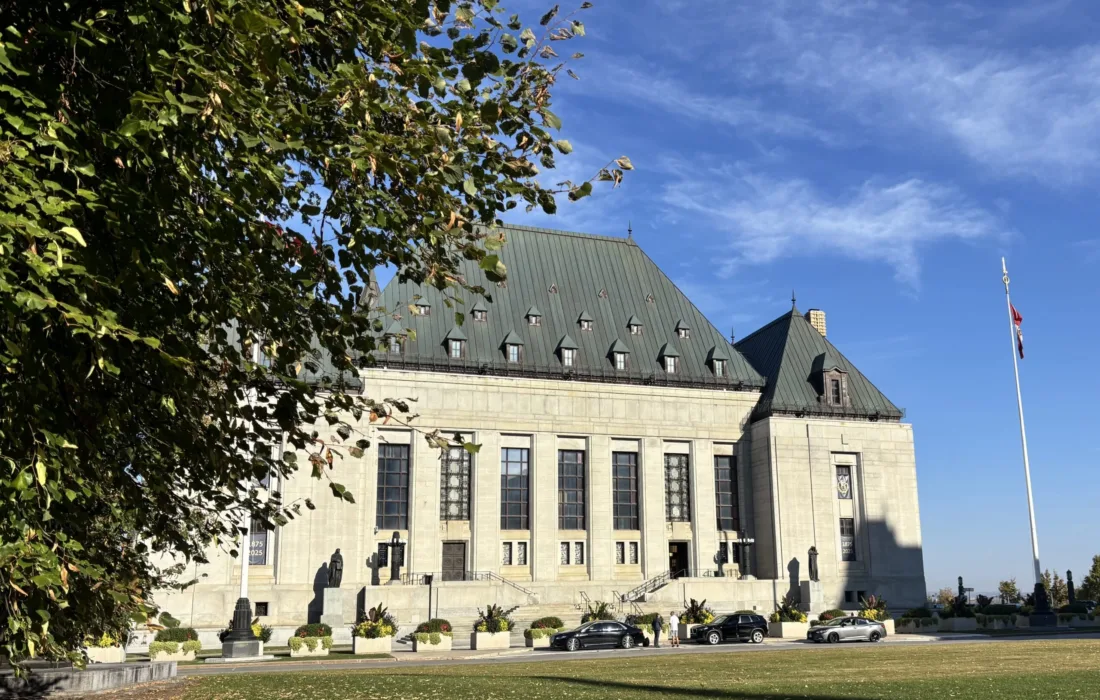
The Criminal Lawyers’ Association intervenes on significant criminal law cases at the Supreme Court of Canada with the pro-bono support of its members.
- The CLA will intervene before the Supreme Court in November 2026 in R. v. Bowcock. This appeal affords the SCC an opportunity to provide guidance on the proper approach to jury instructions concerning eyewitness identification, recognition, or description evidence. The CLA will be advancing two submissions: First, the traditional instruction regarding eyewitness identification evidence and the risk of wrongful conviction should always be given where the evidence tends to inculpate the accused. However, where eyewitness evidence is exculpatory, no special instruction concerning the frailties of eyewitness evidence should be given. As in the case of exculpatory evidence from a Vetrovec witness, a W.(D.) instruction should be given in relation to exculpatory evidence and should not be diluted by any instruction that suggests, either explicitly or implicitly, that it is dangerous to rely upon such evidence. Second, where the eyewitness evidence is mixed, the trial judge should address the inculpatory and exculpatory components separately, making it clear to the jury which instruction applies to which portion of the evidence.
- The CLA will intervene before the Supreme Court in November 2026 in R. v. Sarroino. The appeal raised the issue of whether W.(D.) applies beyond the accused’s evidence to other exculpatory evidence led by the Crown or defence. The CLA argued that the principles underlying W.(D.) apply to any direct evidence—whether adduced by the defence or the Crown—that, if accepted within the factual context of a particular case, would make a conviction unreasonable. It follows that a W.(D.) instruction must be provided and expressly related to any evidence that meets this definition. There is no principled reason why the exculpatory testimony of the accused should be treated any differently in this context from other evidence that establishes the innocence of the accused. General instructions on the burden of proof are insufficient where specific exculpatory evidence is engaged.
- On October 6, 2026, the CLA will intervene in the matter of R. v. Chemlal. This is a Crown appeal from a decision of the Court of Appeal of Quebec regarding the applicable standing for justifying a safety search. A majority of the Court of Appeal allowed the appeal, set aside the convictions against Mr. Chemlal, and ordered the entry of acquittals, as safety searches are only authorized if a police officer believes on reasonable grounds that their safety is at risk. In the context of this case, the majority determined that no such reasonable grounds existed, and the uncovered evidence was excluded under s. 24(2). On appeal, the Crown submits that the applicable standard is that of a reasonable suspicion, not belief. The CLA submits that the power to conduct a safety search, especially outside the context of a lawful detention (or arrest), requires the police to have reasonable grounds to believe that their safety or the safety of the public is at risk. As a common law search power, it is imperative that it be appropriately limited. Furthermore, regardless of the applicable standard for safety searches, the CLA submits that the Supreme Court must provide guidelines on how and when police officers are to conduct safety searches. The proposed guidelines would include the following: (1) there must be an imminent threat to safety prior to conducting the search; (2) objectively discernable facts must demonstrate the imminence of the threat; (3) the search must be limited to what is necessary to respond to the threat; and (4) a proper record of the search must be kept by police.
- The mens rea of sexual assault has long been recognized to have two components: (1) intention to touch, and (2) knowing of, or being reckless of or wilfully blind to, a lack of consent on the part of the person touched (the “knowledge component”). R v Degale and R v Bilinski presented an opportunity for the SCC to clarify the distinction between the knowledge component of the mens rea, and the defence of honest but mistaken belief in communicated consent. In Bilinski, the CLA took the position that the Crown must always prove the knowledge component of the mens rea beyond a reasonable doubt, regardless of whether the defence is raised, and that eliminating this requirement will reverse the burden of proof. An instruction directing the jury that they should have little difficulty in finding that the Crown has met its burden with respect to the knowledge component should only ever be given where there is no dispute on the facts that the mens rea has been established. In Degale, the CLA took the same position regarding the reversal of the burden of proof, and presented plausible fact scenarios in which an accused can have a non-culpable state of mind while being unable to raise the defence of honest but mistaken belief in communicated consent. Both appeals were heard in May 2026, and the decisions are pending.
- In February 2026, the CLA intervened before the SCC in R. v. A.M. The appeal focused on the interpretation of s. 276 of the Criminal Code in the context of human trafficking and sexual services offences. The appeal also raised the issue of whether a court may consider a complainant’s prior voluntary participation in sex work when assessing alleged exploitation, or whether doing so improperly engages the “twin myths”. The CLA argued that exploitation and consent are distinct legal inquiries: while the twin myths bar propensity reasoning about consent or credibility, they do not preclude contextual evidence of influence or exploitation, which focuses on power, control, and autonomy over time. In trafficking and sexual services cases, prior voluntary sex work may provide the necessary baseline against which a court evaluates whether an accused materially altered a complainant’s working conditions or decision-making. Properly used, this evidence does not rely on discriminatory stereotypes and ought to continue to be assessed under the ordinary rules of evidence to preserve the integrity of the truth-seeking process.
- The Criminal Lawyers’ Association intervened in the matter of Attorney General of Quebec v. Luamba before the Supreme Court on January 19 and 20, 2026. Luamba was an appeal from a decision of the Quebec Court of Appeal ruling that provincial legislation which allows police officers to pull over drivers on the roadside in the absence of reasonable grounds to suspect was discriminatory under s. 15 of the Canadian Charter. The CLA argued that the Supreme Court should uphold the Court of Appeal’s decision. The CLA’s submissions focused on how low-threshold police powers, that is, powers that can be exercised in the absence of an objective threshold like the existence of reasonable grounds to believe an offence was committed, cause discrimination. Where the police’s decision to detain is not tethered to an objective threshold, the likelihood of profiling is increased, and victims of discrimination are left without a remedy. The Court reserved its decision to a later date.